
How findable are UK construction firms? What 50 audits tell us
We put 2,717 buyer questions to six AI tools and ran 408 Google searches for 50 UK construction, civils and trades businesses. This is what a buyer actually sees when they go looking for a firm like yours, and what the firms that get found do differently.
- Research by
- Steve Mark, November 2026
- Based on
- 50 audits, 2,717 AI answers, 408 Google searches
In short
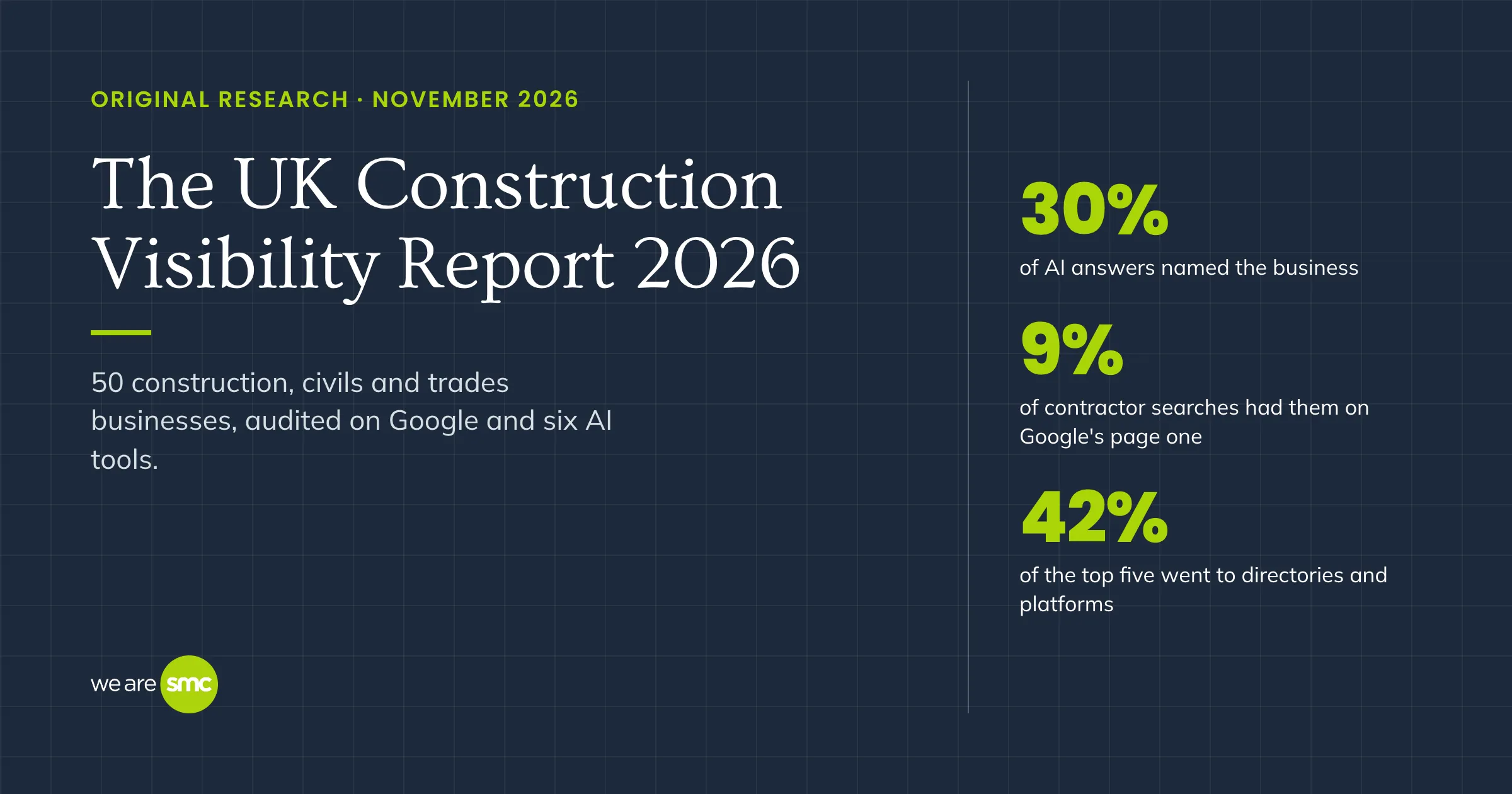
AI tools named the business in 30% of answers to buyer questions about its own work. Google put a contractor on page one for 9% of searches for what it does. Directories, trade bodies and social sites took 42% of the top five results.
The firms AI names most are not the ones with the best websites. They are the ones other websites talk about. And being ready for a tender, with every policy and accreditation on show, made little difference to how findable a contractor was.
What's in here
Eight findings, each with what it means for your business, then ten steps to act on them in order. Every number comes from our own audits. No business is named.
Free, no email required.
The findings at a glance
50 UK construction, civils and trades businesses, audited on Google and six AI tools.
- Named by AI
- 30%AI tools named the business in 809 of 2,717 answers to buyer questions about its own work and area.
- On Google's page one
- 9%of searches for what a contractor does put it on page one. 26 of the 42 contractors were on page one for none.
- Taken by directories
- 42%of the top five Google results for contractor searches went to directories, trade bodies, job boards and social sites.
- Cited by AI Overviews
- 4%of contractor searches had a Google AI Overview citing the firm's own site. Google showed an Overview on 71%.
- Described wrongly
- 35%of AI descriptions of a contractor got something wrong or left a gap. Size was the most common mistake.
- Capability statements
- 2 of 42contractors offered a capability statement a buyer could download from their website.
- The authority gap
- 14xmore websites link to the ten most-named contractors than to the ten least-named, comparing the middle firm of each group.
- Slow on a phone
- 37 of 42contractor homepages took longer than 4 seconds to show their main content in Google's phone test.
Why this data is different
Most reports on construction marketing are surveys: firms telling a researcher what they think they do. This is not a survey. Every figure here comes from a live check of what a buyer sees.
It comes from real audits
Each business went through the same engine that writes our free website and tender-ready audits. Nobody filled in a form about themselves. We looked, the way a buyer would.
Real buyer questions, six AI tools
We asked 443 different questions a buyer would ask, written for each firm's own work and area, and put each one to ChatGPT, Gemini, Perplexity, Claude, Google AI Overviews and Google AI Mode.
Every search checked twice
Google results move between checks minutes apart. Each search ran twice, and a position only counts where both checks agreed.
Every website finding has a quote
When we say a website shows a policy or an accreditation, the audit found the words on the page. Where it could not, it says no.
Who is in the 50
- 42civils and construction contractors
- Medium and large firms selected from Companies House accounts, working across the UK, plus one contractor audited on request.
- 6local trades businesses
- Plumbers, heating engineers, a garden designer and a carpet cleaner, audited on request.
- 2construction suppliers
- Tool and plant hire for builders, and CIS compliance for contractors, audited on request.
Fieldwork ran from 20 October to 4 November 2026. No business is named in this report, and none will be. Where a finding covers only the 42 contractors, we say so.
1. AI names you about three times in ten, and it depends which tool your buyer uses
When a buyer asked an AI tool to recommend a firm for the exact work one of our 50 does, in the area it does it, the tool named that firm in 30% of answers. Its own website was linked as a source in 22%.
- ChatGPT189 of 479 answers39%
- Perplexity170 of 479 answers35%
- Gemini133 of 479 answers28%
- Google AI Overviews97 of 322 answers30%
- Claude122 of 479 answers25%
- Google AI Mode98 of 479 answers20%
All 50 businesses, 2,717 answers. Google only writes an AI Overview for some questions, so it answered fewer.
- The range was huge: from 2% of answers for the least-named business to 80% for the most-named.
- 17 of the 50 were named in fewer than one answer in five. 8 were named in half or more.
- ChatGPT named the business most often. Google AI Mode named it least, in 20% of answers, even though it draws on the same index as Google search.
What it means for you
- Your buyer's choice of tool changes whether you are on the shortlist. Check more than one.
- Being named is not the same as being recommended first, but it is the price of entry. A firm that is never named is never considered.
- Your own site being cited as a source is the strongest signal you can influence directly. It means the tool read your page and trusted it.
2. Google's page one belongs to directories, not contractors
We searched Google the way a buyer would, for each contractor's disciplines in the regions it works: 273 searches whose two checks agreed. The contractor was on page one for 25 of them, 9%.
- 26 of the 42 contractors were not on page one for any search for what they do.
- 42% of the top five results went to third parties: directories, trade bodies, business data sites, job boards and social media.
- For local trades it was 58%, led by Checkatrade, Facebook, TrustATrader and Yell.
| Site | What it is | Times in the top five |
|---|---|---|
| construction.co.uk | Directory | 75 |
| yell.com | Directory | 63 |
| ceca.co.uk | Trade body | 55 |
| facebook.com | Social media | 44 |
| directory.highwaysindustry.com | Directory | 38 |
| revenuebase.ai | Business data site | 32 |
Times each site appeared in the top five organic results across the contractor searches.
3. Google writes an answer on most contractor searches, and rarely cites the contractor
Google showed an AI Overview at the top of 71% of contractor searches (220 of 312). The contractor's own website was cited as a source in 14 of them.
- Showed an AI Overview220 of 312 searches71%
- Overview cited the contractor's own site14 of 312 searches4%
What it means for you
- On most searches for your work, a buyer now reads Google's summary before they see a single result.
- Overviews cite pages that answer the search plainly: a page for a discipline in a region, a project with its scope and value, a straight answer to a common question.
- A homepage that says "delivering excellence across the UK" gives Google nothing to quote.
4. AI mostly knows who you are, and often gets your size wrong
We asked each of the six tools what it could tell a buyer about each of the 42 contractors, then checked every answer against the firm's own website and its Companies House record. That gave 252 descriptions.
- Accurate
- 165
- Partly right
- 79
- Wrong
- 2
- No answer
- 6
65% were accurate. Only 8 of the 42 contractors were described accurately by all six tools.
- Size: staff numbers or turnover25 of 42 contractors60%
- Offices, regions or address17 of 42 contractors40%
- Sectors or services16 of 42 contractors38%
- Accreditations16 of 42 contractors38%
- History, ownership or dates14 of 42 contractors33%
The kind of mistakes we found
- A firm with more than 250 people on its own site described as having about 50 direct employees.
- An employee-owned business described as family-owned, or as privately controlled.
- A head office address that is not the firm's current one.
- Turnover and headcount taken from business data websites instead of the firm's own figures.
- Sectors and regions the firm does not work in, and accreditations it does not hold in full.
5. Being bid-ready doesn't make you findable
Every contractor got two scores out of 100: how tender-ready its website is for a procurement team, and how discoverable it is on Google and AI. Tender readiness averaged 64. Discoverability averaged 45.
| Average | Lowest | Highest | |
|---|---|---|---|
| Tender readiness | 64 | 19 | 96 |
| Discoverability | 45 | 19 | 65 |
- The firms in the top half for tender readiness were barely more discoverable than the bottom half: 47 against 43.
- Firms with more project pages scored much higher on tender readiness. They were no more likely to be named by AI.
- A contractor can have every policy, accreditation and case study a procurement team wants, and still be invisible to the buyer who has not heard of it yet.
Steve says
These are two different jobs. Tender readiness gets you through the door once a buyer has found you. Discoverability decides whether they find you at all. Most firms we see have put their effort into the first and assumed it covers the second. It doesn't.
7. The procurement checklist: what 42 contractor websites show a buyer
Before a procurement team shortlists you, it checks your website. We looked for what it looks for, and only counted an item where the website showed it in full.
- Clients named38 of 4290%
- Sectors they work in, stated clearly33 of 4279%
- Environmental policy28 of 4267%
- Health and safety policy26 of 4262%
- Modern slavery statement25 of 4260%
- Leadership team named25 of 4260%
- Size shown (staff, turnover or project values)23 of 4255%
- Regions they cover, stated clearly21 of 4250%
- Quality policy19 of 4245%
- Social value commitments17 of 4240%
- Frameworks named15 of 4236%
- Carbon reduction plan14 of 4233%
- Equality and diversity policy14 of 4233%
- Client testimonials10 of 4224%
- A clear route for procurement teams6 of 4214%
- Downloadable capability statement2 of 425%
- A prequalification scheme (CHAS, Constructionline, Achilles, SMAS and so on)27 of 4264%
- ISO 45001 (health and safety)25 of 4260%
- ISO 9001 (quality)23 of 4255%
- ISO 14001 (environment)23 of 4255%
- A sector scheme (NERS, UVDB, Sentinel and so on)20 of 4248%
- Considerate Constructors Scheme7 of 4217%
- 37 of the 42 had project case studies. 5 had no project pages at all.
- Only 15 contractors' case studies showed social value, though public sector tenders often score it.
- Only 14 showed a carbon reduction plan. Central government asks for one on contracts worth more than £5 million a year.
- A clear route in for procurement teams, such as a named contact or a supply chain page, was on 6 websites.
8. Slow on a phone, and hard for machines to read
- 37 of 42 contractor homepages took longer than 4 seconds to show their main content in Google's phone test. The middle site took 8.4 seconds. Google rates over 4 seconds as poor.
- 19 of the 42 had the structured data that tells Google and AI tools who the company is, where it is and what it does. 11 had no structured data at all.
Google's phone test simulates a mid-range phone on a slow mobile connection. Real visitors on fast connections will often see the page sooner, but Google only had real-visitor data for a minority of these sites.
Local trades and suppliers: a smaller snapshot
Eight of our 50 were local trades businesses and construction suppliers. That is too few to generalise from, so treat these as field notes rather than a benchmark.
- AI tools named them in 27% of answers to local buyer questions, close to the contractors' figure.
- Google AI Mode named them in just 8% of answers (5 of 59).
- They were on Google's page one for 15% of searches for their services in their own towns.
- Directories, Google's own listings and social sites took 58% of the top five results. Checkatrade alone appeared 54 times.
If you're weighing up lead sites against your own website, read Checkatrade vs Rated People vs your own website.
What to do: ten steps, in order
The order matters. The first steps cost nothing but an afternoon, and each one makes the next work harder for you.
Ask the AI tools yourself
Put three questions your buyers would ask to ChatGPT, Gemini and Google. Write down who gets named. That is your real competition.
Write your facts page
Headcount, turnover band, offices, sectors, regions, ownership and accreditations on one page, in plain sentences. Then make Companies House and LinkedIn match.
Fix the listings Google already ranks
Claim and complete your profile on the directories and trade body sites that show up for your searches. Same name, address and phone everywhere.
Build the procurement pack
Policies, carbon reduction plan, modern slavery statement, insurances, accreditations with expiry dates and a capability statement, on one page from the main menu.
Name a route for procurement teams
A named person or a supply chain page, so a buyer knows who to ask for documents without filling in a general contact form.
Turn projects into answers
One page per project with the client, scope, value, programme, outcome and social value. Write the title the way a buyer would search for that kind of job.
Give each discipline and region a page
If you want to be found for drainage in Yorkshire, you need a page that says you do drainage in Yorkshire, with the projects to prove it.
Earn mentions on other sites
Trade press, trade bodies, clients, frameworks and suppliers. One good placement a month moves you faster than another month of website changes.
Speed up the homepage on a phone
Compress the hero image or video, cut the plug-ins you don't use, and test it on Google's PageSpeed Insights until the main content shows inside 4 seconds.
Add Organization structured data
A short block of code that tells machines your name, logo, address, contact details and social profiles. Your web developer can add it in an hour.
Then check again in three months. AI answers and Google results change, and the only way to know if the work is landing is to ask the same questions again.
How we did it
- The sample
- 42 civils and construction contractors: 41 medium and large firms chosen from Companies House accounts and checked by hand, and one audited on request. 6 local trades businesses and 2 construction suppliers, all audited on request. Where a business was audited twice, we used one audit. Businesses outside construction and the trades were left out. The pool includes two of our own clients; leaving them out moves no headline figure by more than a point.
- The AI questions
- For each business we wrote buyer questions for its own disciplines and area, such as a procurement manager asking for a piling contractor for a flood defence scheme in the North West. Each was put to ChatGPT, Gemini, Perplexity, Claude, Google AI Overviews and Google AI Mode. A business counts as named when the answer named it or linked to its website. 2,717 answers in all.
- The Google searches
- Searches for each business's services in the places it works, run from the UK. Each ran twice, and a position counts only where both checks agreed. Page one means the top ten results or Google's map box. 408 searches in all, 358 with agreeing checks.
- The descriptions
- Each AI tool was asked what it could tell a buyer about the contractor. Each answer was judged against the firm's website and Companies House record as accurate, partly right, wrong or no answer.
- The websites
- The key pages of each contractor's website were read, along with the documents they link to. An item counts only where the audit found the words on the page; partial matches are counted as not shown. Project pages were sampled, up to ten case studies per firm.
- Links, speed and structure
- Linking websites come from a backlink index and are estimates. Speed is Google's PageSpeed Insights phone test of each homepage. Structured data was read from the homepage and key pages.
Using this research
You are welcome to quote these findings and reproduce the charts, with credit to We Are SMC and a link to this page.
Journalists and trade bodies: if you'd like a figure broken down differently, or want to talk to Steve about what it means for your readers or members, get in touch through our contact page.
Common questions
How often do AI tools recommend UK construction firms?
In our audits of 50 UK construction, civils and trades businesses, AI tools named the business in 30% of answers to buyer questions about its own work and area. ChatGPT named firms most often (39%) and Google AI Mode least (20%).
Do contractors rank on Google for what they do?
Rarely. Across 273 searches for contractors' disciplines in the regions they work, the contractor was on page one 9% of the time, and 26 of 42 were on page one for none. Directories, trade bodies and social sites took 42% of the top five results.
Does a tender-ready website help a contractor get found?
Very little on its own. The contractors with the most tender-ready websites were barely more discoverable than the rest. Tender readiness helps once a buyer has found you; being found depends far more on what other websites say about you.
What makes AI tools name one contractor over another?
The clearest difference in our data was reputation on the wider web. The ten most-named contractors had a median of 1,486 websites linking to them, against 103 for the ten least-named, and AI tools linked to their own sites far more often.
Can I get these checks run on my own business?
Yes. Our free tender-ready audit runs the same checks for civils and construction firms, and our free website audit does the same for trades businesses. Each comes back as a short report with your scores and what to fix first.
Free, no email required.
Want to see your own numbers?
Our free tender-ready audit runs every check in this report on your firm, and tells you what to fix first.